
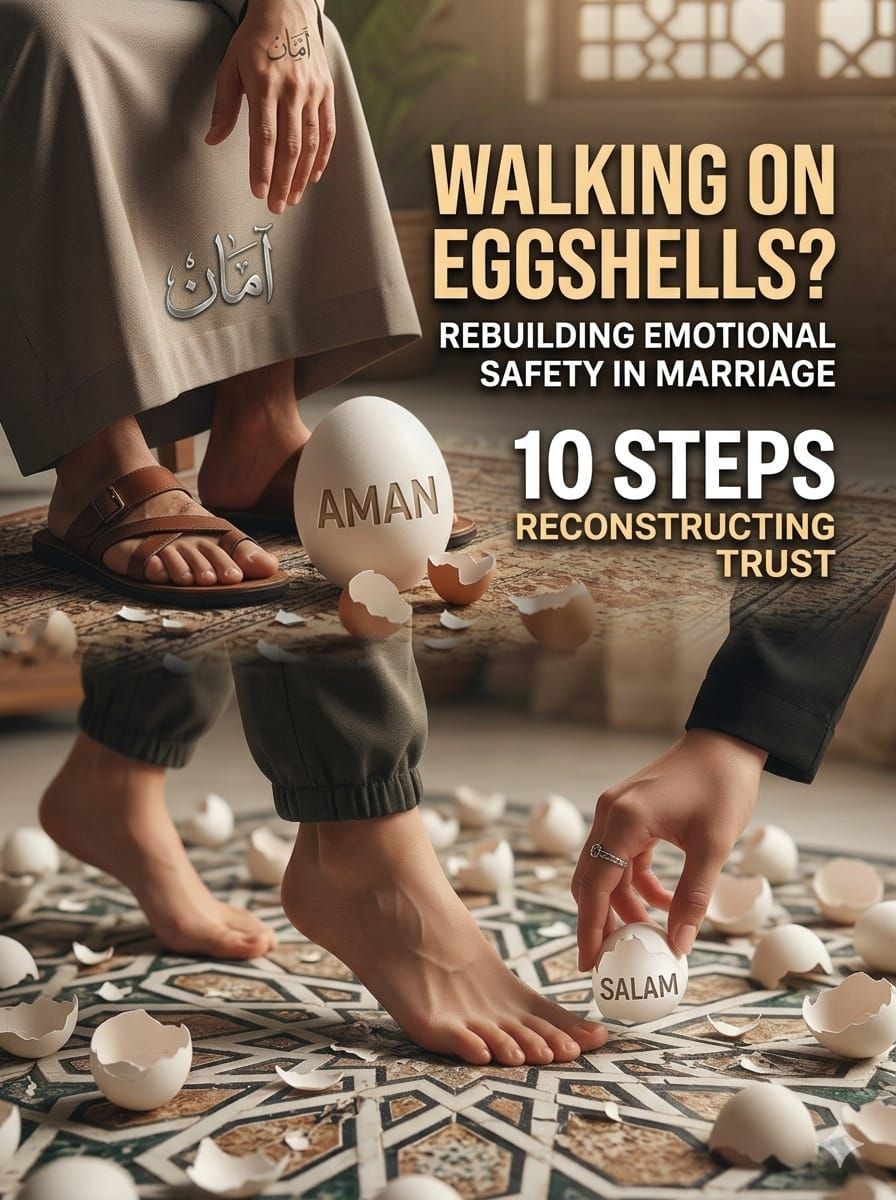
When Love Feels Like Walking on Eggshells: Rebuilding Emotional Safety
By Imam Ayman Al-Taher
Registered Psychotherapist | Al-Iman Family Services (AIFS)
In my clinical practice with Al-Iman Family Services, when couples sit on my counseling couch, their presenting struggle almost always sounds familiar: "We’ve grown apart," "We can’t stop bickering," or "We are just mentally and emotionally exhausted."
Many reach a painful breaking point where continuing their shared journey peacefully feels out of reach. Yet, sitting with these couples week after week reveals a consistent truth: their breakdown rarely stems from an inherent lack of love or basic incompatibility.
The core missing ingredient—the vital foundation holding a relationship together—is emotional safety.
When emotional safety erodes, a home stops being a sanctuary of peace (Sakinah) and turns into a source of chronic friction.
What the Absence of Emotional Safety Feels Like
Without emotional safety, human survival instincts kick in. The brain’s alarm system—the amygdala—floods the nervous system with stress hormones like cortisol and adrenaline. In a domestic setting, that alarm isn’t triggered by physical danger, but by threat cues like criticism, contempt, or emotional rejection.
This survival state produces three unmistakable patterns in a home:
Defining True Emotional Safety: The Three Pillars
Every human being enters a relationship carrying four foundational needs first nurtured in childhood: to feel seen, soothed, safe, and secure. In a marriage, this security rests upon three non-negotiable pillars:
When these three pillars are present, couples shift from merely surviving or settling for superficial tolerance to truly thriving together.
Root Causes: Why Does Emotional Safety Fade?
Emotional safety rarely disappears overnight. It gradually erodes through predictable blind spots:
The Strategic Shift: The Emotional Bank Account
Before a couple can resolve complex disagreements, they must understand their Emotional Bank Account.
Every criticism, eye roll, defensive reaction, or period of cold withdrawal acts as a major withdrawal. Conversely, every gentle check-in, validated feeling, sincere apology, and warm gesture serves as an intentional deposit.
When an emotional account is overdrawn, even benign, neutral comments are perceived as attacks. To build genuine emotional safety, you must make consistent, deliberate deposits before attempting to navigate difficult, sensitive conversations.
10 Steps to Build Lasting Emotional Safety
Drawing from clinical psychotherapy and timeless Islamic principles, here are the 10 deliberate practices to replenish your relationship’s emotional bank account and restore safety:
1. Cultivate Empathy
Step out of your own defensive narrative and inhabit your partner’s emotional reality. Empathy means genuinely caring about their pain—even when you believe their reaction is unreasonable. Connection always precedes resolution.
2. Validate Before You Correct
When your partner shares an issue, suppress the urge to offer immediate logic, fix the facts, or defend yourself. Validate the emotion first: "I can see why that felt overwhelming and lonely for you." Validation connects hearts; premature correction drives people into isolation.
3. Expand Your Horizon: Give the Benefit of the Doubt (Husn al-Dhann)
Stop interpreting your partner’s clumsy moments, exhaustion, or poor phrasing through a lens of malice. Expand your perspective, recognize their human limitations, and actively assume positive intentions until proven otherwise.
4. Listen More, Talk Less
Create a spacious environment where your partner can process their feelings without being rushed or interrupted. Restrain the internal impulse to formulate a rebuttal. Deep listening is an act of generosity that honors the other person’s presence.
5. Cultivate Forgiveness & Acceptance
A healthy relationship requires two generous forgivers. Let go of keeping score and dredging up resolved arguments as debate leverage. Pair forgiveness with realistic acceptance: your partner is an imperfect human being doing their best with the tools they currently have.
6. Add Spirituality: View the Bond as ‘Ibadah
Elevate your everyday interactions into acts of worship. When patience, softness, and restraint are practiced for the sake of Allah, your behavior is no longer held hostage by whether your spouse "deserves" it in that moment. You act with excellence (Ihsan) because Allah loves those who do good.
7. Create Mawaddah (Deep, Expressive Affection)
Mawaddah is active, visible affection. It is sustained through tender touch, sincere compliments, spontaneous acts of kindness, and shared quality time. It keeps the emotional reservoir full so everyday stresses do not dry out the relationship.
8. Create Rahmah (Active Compassion & Mercy)
While Mawaddah carries you through pleasant times, Rahmah sustains you through hardship, weakness, and fatigue. It is the mercy that restrains your tongue during an argument, protecting your partner’s dignity rather than fighting to win.
9. Practice Sabr (Patient Endurance)
Meaningful emotional transformation does not happen overnight. Sabr is not passive victimization; it is active emotional regulation, perseverance through rough patches, and keeping your eyes anchored to the long-term vision of a peaceful home and the ultimate reward in Jannah.
10. Take the Lead
Do not wait for your partner to wave the white flag or show softness first. Break the cycle of mutual standoff. Be the first to apologize, the first to validate, and the first to offer warmth. Real leadership in a relationship is having the courage to extend safety first.
About the Author
Imam Ayman Al-Taher is a Registered Psychotherapist with Al-Iman Family Services (AIFS), specializing in couple, marriage, and family therapy. He integrates evidence-based clinical modalities with Islamic principles of spiritual and emotional wellness to help families transform friction into lasting peace.
